Ten tips for collecting reviews
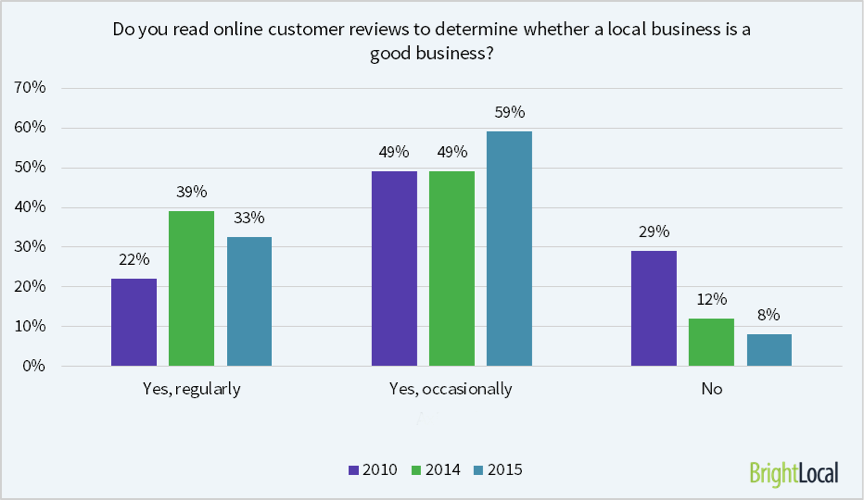
People use reviews in their purchasing process. Recent research by Brightlocal shows that 92 percent now read reviews to determine whether a local company scores well. In addition, 80 percent of trust reviews as much as personal recommendations.
The impact of reviews is also increasing. The more reviews, the higher the conversion. According to Reevo, this results in a 4.6 percent increase for 50 or more reviews. Research from iPerceptions shows that 63 percent of customers prefer to buy on a site with reviews. This impact does not only apply to B2C, but also to B2B.
So customer reviews are important, but are you making sure they share those experiences?
It is important to give people a reason to leave a review. Customers take action spontaneously if they have a very positive or negative experience. However, these are the outliers. The large group of customers who are 'quite satisfied' will be less inclined to leave a review. Unless you are a company with a very good reputation and a steady clientele, you need a fair number of reviews about your product or business to get customers to you. It is therefore important to convince your customers to give a review. If you want to boost your google presence then check out our google review software.
Send an email
Make sure you get an email address from your customer after the purchase, even if you are active offline. You can do that by simply asking, linking it to a discount card, or offering a price.
If your customer has made a purchase, send him an email with a simple question. For example, Groupon just asks if you would recommend the company or not. If you then click on this, the further questionnaire will open. You have already drawn the customer into the process and will be more inclined to answer the rest of the questions. Booking uses the same tactic and asks in an accessible manner the question of how the stay is experienced.
Ask on the receipt or invoice
As a company, you want reviews to actually come from real customers. You can do this by sending an email, but if you don't have one, you can also look at other solutions such as using the invoice or the receipt. Ami Kappers asks their customers to leave a review on the website, using the receipt as a unique identifier. For example, AMI knows that only customers who have actually visited the hair salon give their opinion and compete for the price associated with it.
Use your customer satisfaction survey
As a company, you can use your customer satisfaction survey to gain better insights and to achieve a more customer-oriented organization. With the help of Closed Loop Feedback, you can receive continuous feedback from customers and follow up on that feedback immediately. The customer can be questioned after each contact moment. These studies are generally conducted internally. However, this system can also be ideally used to also ask customers to leave a (public) review about the company with which you make your results transparent and show how you score. You can use reputation management software free for reviews.
Provide an incentive
Give a little, take a little. Most people only take action when there is possibly something in return. Therefore, a giveaway can help to collect more reviews. In addition, it helps that the prize to be won matches the interests of the participants. For example, the customer at AMI Kappers has a chance to win a hairdressing voucher, a review on Bed & Breakfast.nl can lead to a free night and Media Markt offers the prospect of a gift card for their own store.
Introduce customers to your product or service and ask for a review
Many customers are willing to share their experiences with your product or service if they can try it for a while or even keep it afterward. This allows you to collect a lot of feedback and even fine-tune a product or service before the official launch.
Use stickers and flyers
Make sure that the customers find their way to the review. For example, give a flyer or card to your customer. This is already widely used in the restaurant and travel industry. For example, Lens has business cards that allow restaurants to point customers to the review site and ask them to share their experience. With stickers on the door, estaurants and hotels ('recommended on Zoover') also show that reviews are important to them.
Add reviews to your website
An important means of generating reviews is to display them on your website. You show your customers that you are transparent and open to feedback. For example, Simyo uses its own tool to collect and display reviews on their website. This does not prevent them from leaving negative reviews in addition to the positive ones. ASN uses the customer satisfaction survey of Tevreden.nl to collect reviews and post them on its own platform.
Neckermann has integrated the Zoover reviews for all hotels and apartments it offers through the site. The Mediamarkt does not show reviews on its own platform but has integrated the Kieskeurig.nl review form on the site. In doing so, they call on customers to share their experience on a platform where potential customers compare suppliers before making a purchase.
Make sure you can be found on review platforms
Because 90 percent read reviews when searching for companies, it is important that you can be found on the review sites. Make sure the information is up to date so that customers can find you. Try to direct it in such a way that your customers leave reviews on the platforms that are important to your business.
Link to external reviews
It helps if you show your customers how your performance is on review websites. All secure shows on its own website, for example, what the score is on assessment platforms such as Independent, Openness, and the Consumentenbond. In addition, it refers to the score that customers give via the customer satisfaction survey that they conduct in collaboration with Metrixlab.
Ditto shows on its own platform what the scores are given to customers in the customer satisfaction survey. They show which things are going well, but also explain why a score has plummeted. They also link to the reviews collected on Kiyoh.
Respond to feedback
If you respond to reviews you show that you take the customer seriously. If it is a negative experience and you know how to solve it, this is not only positive for the customer. You also show other potential customers that you listen to criticism and try to find a solution for it.
If you show that you respond to feedback, other customers will be more likely to give their opinion, because they see that something is being done with it.
Related post:
https://freshreviewonline.wordpress.com/2020/12/02/review-marketing-why-how-and-what/
https://freshreviewofficial.tumblr.com/post/637571192436473856/dealing-with-negative-reviews-8-tips
Comments
Post a Comment